Core gameplay
A simple chain. A rule that opens under your finger.
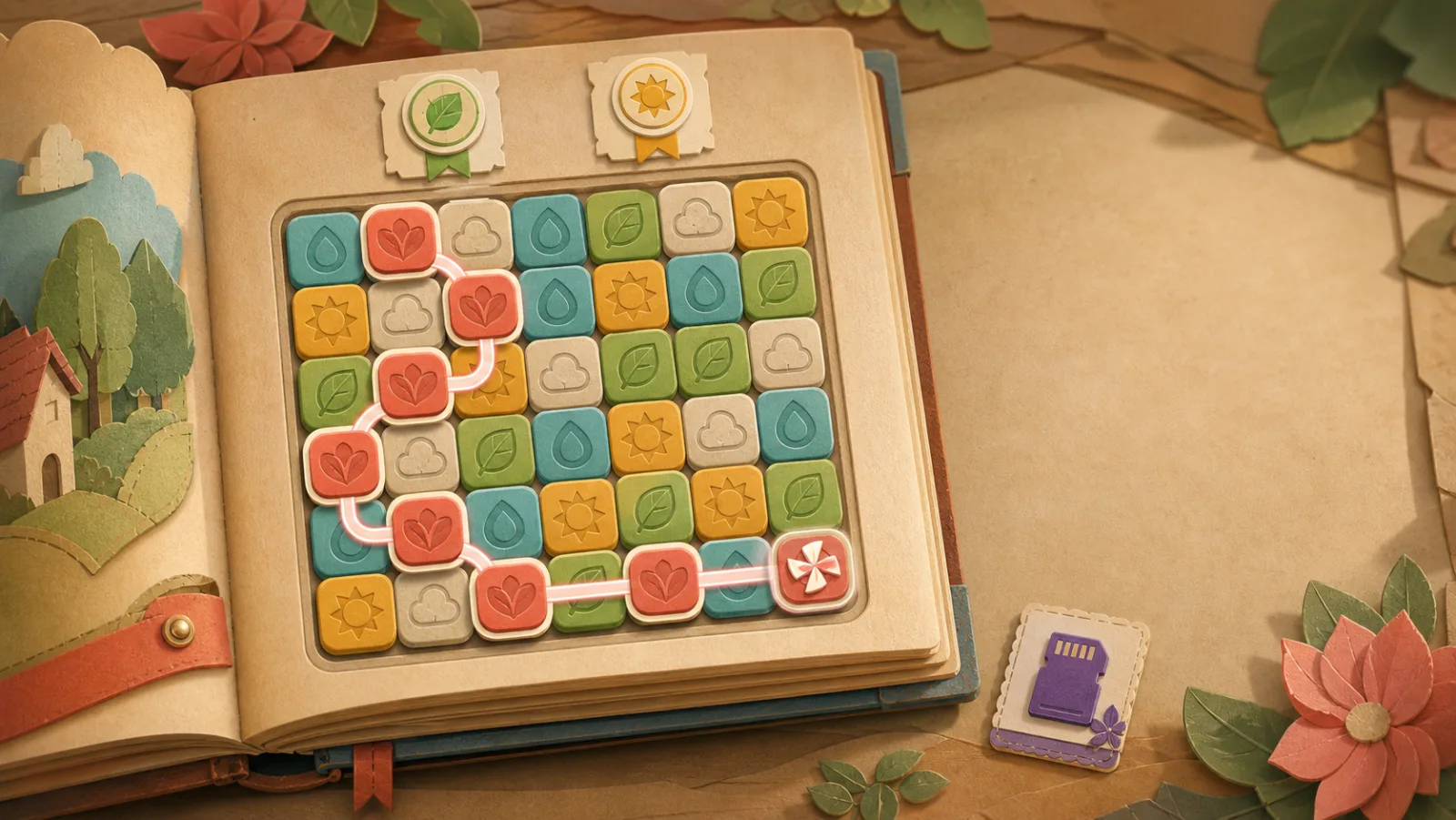
Peel Tales begins with familiar adjacency and then rewards control. Reach the fifth valid tile and the corners open for the sixth and every valid link after it.
The exact rule
Orthogonal first. Diagonal when earned.
- Start on a selectable tile.
- Connect matching valid neighbors up, down, left, or right.
- Reach five selected tiles.
- From the sixth tile onward, true corner neighbors become valid too.
- Backtrack below five and diagonal candidates close immediately.
This is a deterministic educational diagram, not a playable copy of the game. It enforces the real rule: it will refuse a diagonal while the chain holds fewer than five tiles — including after you backtrack — and never allows repeated tiles or two-cell jumps.
Gameplay capture · iOS Simulator
Chain tiers
Every extra link should feel earned.
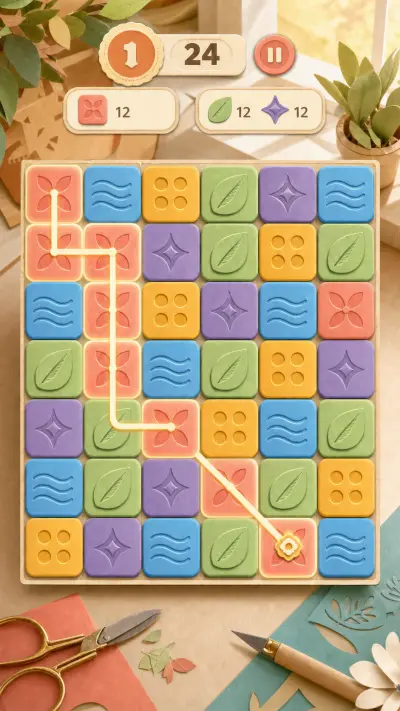
A clean connection, clear score, and a precise paper response.
Diagonal freedom, a stronger score beat, and the first long-chain reward tier.
A richer trail, a higher multiplier, and a controlled special opportunity.
Premium feedback, a personal-record check, and the strongest bounded reward.
Special tools
Powerful because they are bounded.
Pulse
A compact local effect for the first long-chain reward tier.
Directional Cut
A controlled row, column, or directional clear that rewards planning.
Color Removal
A high-tier tool that targets a color family without guaranteeing the level.
Punch and Scissors
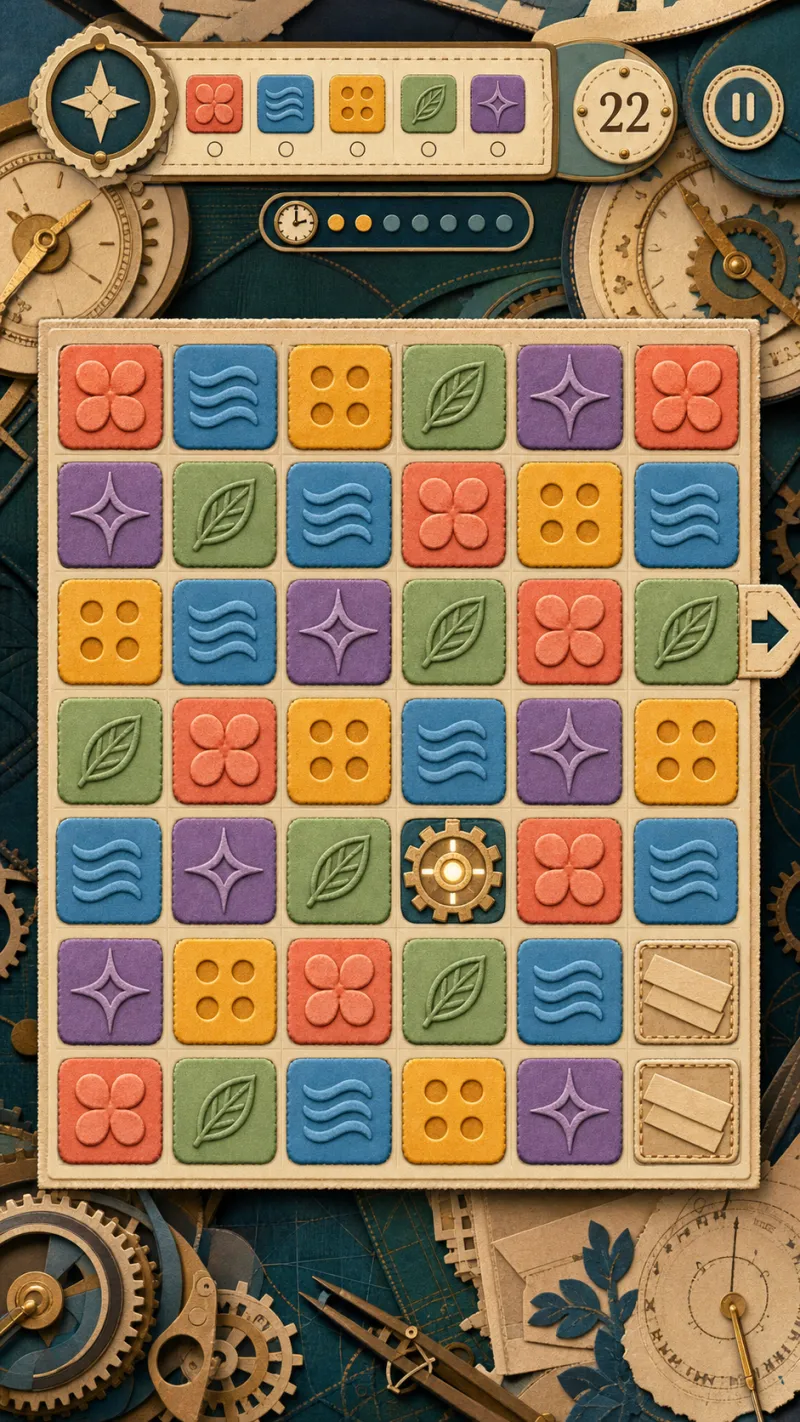
Paper tools that make their effect readable before the board resolves.
Gameplay capture · iOS Simulator
Objectives & materials
The board asks for more than one kind of answer.
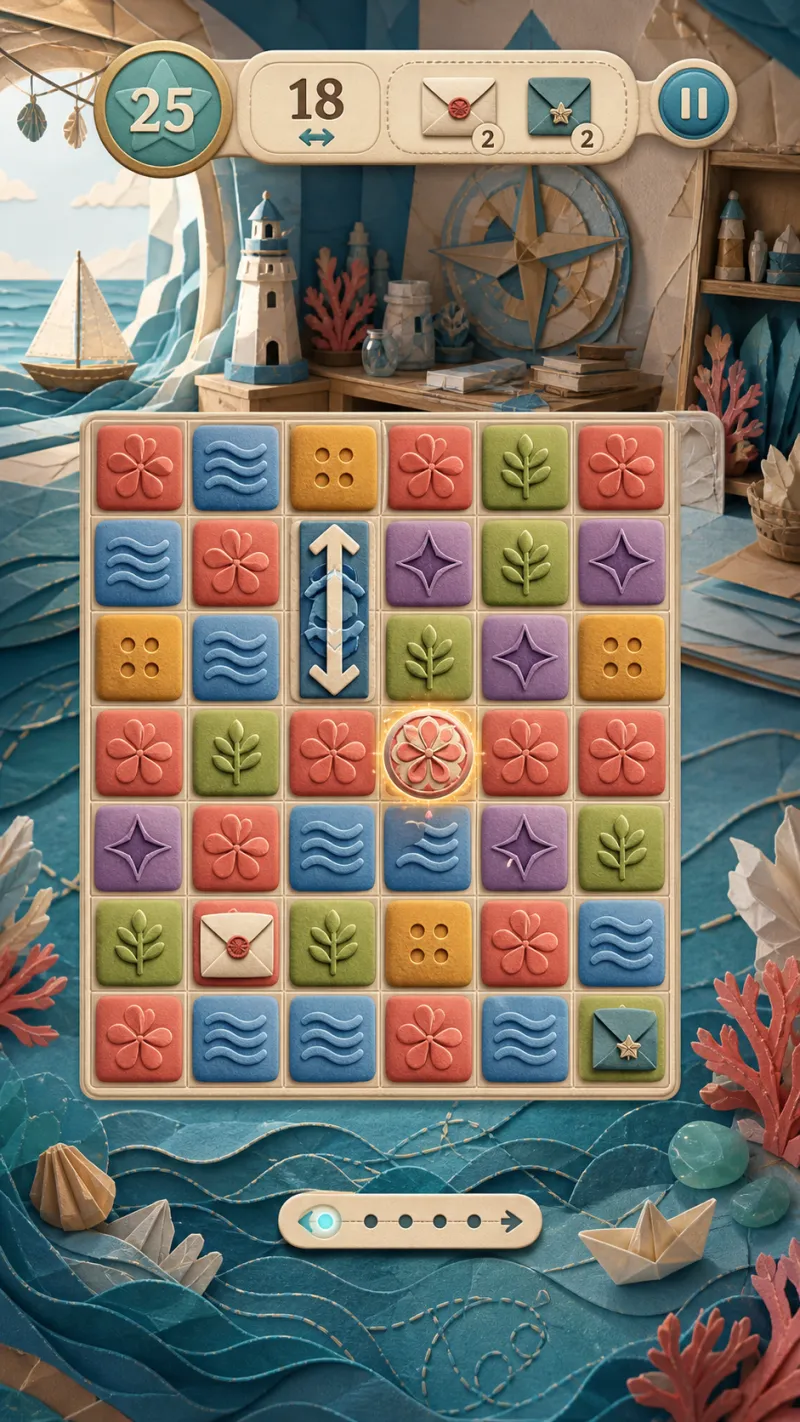
Collection goals, blocker clearing, letter drops, hidden-object reveals, side targets, board shifts, and finale conditions rotate through the campaign. Tape, glue, ink, staples, folded locks, and thick paper are board materials to work through — not enemies.
- Collect — gather what the level names, in the moves you have.
- Clear — cut through material that resists a single touch.
- Reveal — uncover letters and hidden objects beneath the board.
- Finish — chapter finales combine the world's own conditions.
| Profile | Character |
|---|---|
| Balanced | An even, readable spread of families. |
| Clustered | Colors gather — long chains invite planning. |
| Volatile | Faster variety, shorter windows. |
| Combo Friendly | Openings for consecutive strong releases. |
| Constrained | Tighter boards that reward precision. |
| Target Focused | Objective families stay in honest reach. |
| Dynamic | The profile itself shifts as the level unfolds. |
Board Director
Controlled variety, not a coin flip.
A reproducible seed drives each board. Weighted color bags, recent-color history, density targets, local cluster control, target-aware spawn, profile selection, move checks, and anti-repeat comparison shape the result. The board can surprise the player without secretly punishing them.
When no meaningful chain remains, the game does not charge a move or wait for a dead tap. It reshuffles visibly, checks the new board, and falls back to a safe seed if needed.
Final-vision concept
Accessibility
State, shape, sound, and motion all tell the same story.
- Embossed symbols reinforce color families.
- Music, sound effects, and haptics can be adjusted independently.
- Pattern support improves color differentiation.
- Reduced Motion replaces strong transforms with calmer transitions.
- Turkish and English UI support are part of the current direction.
- Safe areas and readable contrast are explicit quality gates.
Gameplay capture · iOS Simulator
Moving proof